
Cradle of Forestry
Site History
Where American Forestry Took Root
The Cradle of Forestry in America preserves the place where professional forestry education began in the United States. Here in the Pink Beds valley, the forests of George Vanderbilt’s Biltmore Estate became both a working landscape and an outdoor classroom.
At a time when forests were often viewed as resources to be cut and exhausted, a different idea was beginning to take hold: forests could be studied, managed, used responsibly, and cared for with future generations in mind. The work that began here helped shape forestry as a profession and changed the way Americans understood the value of their forests.
George Vanderbilt’s Forest
When George Vanderbilt began assembling the land surrounding his Biltmore Estate, portions of the property included overworked farmland and heavily cut woodland. With guidance from landscape architect Frederick Law Olmsted, Vanderbilt chose to restore and manage the land rather than continue the wasteful practices that were common at the time.
He first hired trained forester Gifford Pinchot to develop a management plan for the estate. Pinchot was later succeeded by German forester Dr. Carl Alwin Schenck, who expanded the forestry program throughout Vanderbilt’s Pisgah Forest holdings.
Their work helped demonstrate that forests could provide useful resources while remaining healthy and productive over time. This approach was still new in the United States, and the Biltmore Estate became an important early example of large-scale forest management.
Dr. Carl A. Schenck and the Biltmore Forest School
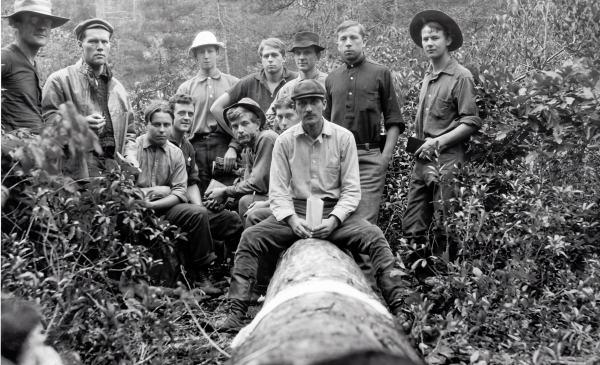
In 1898, Dr. Schenck opened the Biltmore Forest School, the first forestry school in the United States. Rather than relying only on lectures and textbooks, Schenck used the surrounding forest as his classroom.
Students learned by examining trees, measuring timber, surveying land, planning roads and trails, and observing forestry work firsthand. They traveled through the mountains on foot and horseback, gaining practical experience that could not be taught inside a traditional classroom.
Hundreds of students attended the school, and many became part of the first generation of professionally trained American foresters. Although the school eventually moved beyond the original campus and closed in 1913, its hands-on approach helped establish a lasting model for forestry education.
The idea was simple but influential: to understand a forest, students needed to spend time in it.
From Biltmore Estate to Pisgah National Forest
The story continued after the Biltmore Forest School closed. Following George Vanderbilt’s death, Edith Vanderbilt completed the sale of a large portion of the family’s Pisgah Forest holdings to the federal government.
The land became an important part of Pisgah National Forest, formally established in 1916. What began as an effort to restore and manage a private estate became part of a much larger public forest protected for conservation, recreation, education, and responsible use.
In 1968, Congress established the Cradle of Forestry in America to preserve the birthplace of forestry and forestry education in the United States. This designation protected not only the landscape, but also the story of the people, ideas, and early experiments that helped shape modern forestry.
History You Can Walk Through
Today, the Cradle allows visitors to experience that story across the same forested landscape where it all began.
Along the historic Biltmore Campus Trail, preserved and reconstructed structures help illustrate daily life during the Biltmore Forest School era. The schoolhouse, Hiram King House, Commissary, Cantrell Creek Lodge, and other buildings provide a closer look at where early foresters studied, worked, gathered, and lived.
The Forest Festival Trail explores another side of the story through historic forestry and logging equipment. The Climax logging locomotive represents the machinery once used to move timber through the Appalachian Mountains and helps show how forest industries changed during the early twentieth century.
Inside the Discovery Center, exhibits, hands-on activities, and a short film introduce visitors to forestry, conservation, forest science, and the Biltmore Forest School. Outside, the Apollo Moon Tree offers another connection to exploration and discovery, reminding visitors that there is still much to learn about forests and the natural world.
Together, the buildings, trails, exhibits, and artifacts make the Cradle more than a place where history is displayed. It is a place where visitors can walk through the landscape that helped create that history.
FIND Outdoors: Continuing the Legacy
FIND Outdoors’ own story is rooted at the Cradle. The organization began in 1972 as the Cradle of Forestry in America Interpretive Association, formed to support the site and its work with the U.S. Forest Service. As its reach and mission expanded, the organization later became FIND Outdoors.
Today, FIND Outdoors helps operate and interpret the Cradle in partnership with the U.S. Forest Service. Through educational programs, exhibits, trails, guided experiences, and seasonal events, the site continues encouraging people to learn about forests through exploration and discovery.
More than a century after the first forestry students arrived, the Cradle still invites visitors to look at the forest differently—not simply as scenery or a collection of resources, but as a living system that connects people, wildlife, history, and the future.
Every visitor becomes part of that continuing story.